Wednesday, October 5, 2022

Machina Arcana - Descent into Madness (Part 1)

A Thrall manages to get close to Kim. Horror is sure to follow!

Machina Arcana

After playing some horror-themed games recently in the form of Folklore; The Affliction, and Arkham Horror (Living card game) I've developed a taste for blood Cthulu. This has combined with an interest in tactical dungeon crawlers in the form of Machina Arcana, a steampunk exploration and tactical combat game set in a mysterious underground installation.

In this game for 1-4 players you will take control of a small party of explorers who head into this installation, exploring the mysteries it contains as you progress through a story in the form of chapters. Along the way you must tool-up with weapons and armour as quickly as possible to give yourself the best chance of surviving the horrors (both physical and mental) that the installation throws at you.

The challenges you will face include a variety of increasingly horrific monsters from the Cthulu mythos, and more importantly, decisions!
Should you stay and fight? or run? 
Should you head over to that chest for equipment or keep moving? 
When you DO find equipment, what should you keep?
Will you strategically try to stem the flow of monsters, or head on?
Your physical resources are limited, so how will you spend your stamina?

Sounds terrifying good?

Now on its third edition, information on Machina Arcana can be found around the web, including reviews and playthroughs, so in this (lengthy) first post I'll just overview some of the positives of the experience for me so far.

Kim faces a spider of Leng that has webbed her equipment.
Get it back? Or keep moving? (I'll let your arachnophobia decide...)


The highs...


Theme, art, and atmosphere

If you want a game that has a lot of 'theme' '...inspired by the works of H.P. Lovecraft' then this game is for you.
  • 'Cthulu' and a growing sense of unease everywhere, from the monster types and artwork to the thematic text.
  • The 'Steampunk' setting is different and fun. All of the equipment has a suitably 'clockwork' feel and a system of upgrades allowing you to mix and match bits and pieces. (You can learn more about Steampunk by visiting Steampunk Avenue.)
  • The art is gorgeous and visual appeal strong in every element of the components. I really enjoy exploring the chapter artwork (it is revealed as you advance). The characters, monsters, and equipment invite the eye to explore each image - congratulations to the artists on their work.
  • Thematic text is everywhere. Event cards, monster cards, chapter cards etc. all have some text that helps to create and support the theme. Horror and event cards in particular have prose, poems, and rhyme that help to create this dark and dangerous world. Not all players will want to spend the time reading it, but if you like that kind of attention to detail you will find it here. Another example is the monster cards - often you'll find a quote or sentence at the bottom that helps to flesh out the creature.
  • Official soundtrack provides background music by Mladen Konecky (listen to it on Melodice).
  • The atmosphere here is 'struggle' and the mechanics promote this. You don't have a lot health or stamina, and it isn't easy to come by healing, prompting some difficult choices.

The 'Barred' horror event text is one example of the writing.

Variety and replayability

When playing the game, is there variety within a game and replayability afterwards? If you get it to the table multiple times will you feel that the experience is 'different' enough to remain engaging?
I say 'yes', with some qualification.
  • 10 double-sided map tiles provide different layouts to explore as you play each scenario. However the event spaces are printed directly on (you don't randomly add a token in a different spot each mission), so they won't change.
  • Extensive monster variety, with individual A.I. driving their actions. There are 29 in the base game, divided into 4 levels. Will you start to learn what they do with multiple playthroughs? Yes, but in some dungeon crawlers you might find 10 or fewer enemy types.
  • Equipment is plentiful, with an upgrade/ augmentation system allowing you to combine different cards for some cool combinations. The base game has 51 weapons, 40 apparel, 35 artifacts, and 30 consumables.
  • Huge range of different 'events' that will help and hurt players. This is two decks of cards (a total of 120), so you never know what the next event will be. Flipping the horror cards is an exercise in tension. ('Let's dash for the exit - OH NO, paralysing fog!')
  • Explorer choice: Do you want to play as a male or female character? Which of the four classes do you want to be - Bruiser, Gunman, Crafter, or Mystic? Each class has different strengths and weaknesses (and variations in their starting abilities) and will need to be managed differently as you explore. Any class can equip any item, but how easily and quickly they can equip it is the challenge.
Hank, a 'Bruiser'

Lorrai, a 'Mystic'

Kim - 'Gunman' (I'd prefer 'Gunslinger')

Phillip, a 'Crafter'

Large, double-sided map tiles add replayability


Choices

This game is all about making choices, and that is a positive. It does this by having a very tight action economy, imposed by even the hardiest character having a maximum of 6 stamina on their turn. Those stamina are precious! Opening a chest costs 3 stamina, activating a trap costs 2, moving one space costs 1 etc. You can get more stamina by using 'recharge stations' (if you are lucky), but this is occasional. 
Examples of choices you constantly face are:
  • Fight or flight! Taking out monsters can be essential (killing them gives you 'Essence' - a key currency in the game) but just as often it can be better to keep moving.
  • What to equip? Finding useful equipment is really important. When you open a chest or use a workbench you get a choice of items. Which will you keep? This is made more interesting by being able to either destroy an item you don't want or put it back on top of the pile - allowing another explorer to pick it up later.
  • Prioritise exploration or survival? Every map offers opportunities to find new items, but should you split up to hoover up items on the map or stay together and dash towards whatever condition will move the story forward.
An example of choices. Each of these weapons and items
came with a difficult choice about what to keep.

Smooth gameplay & simple combat

Kim and Hank steel themselves. What lies ahead?


Once you have a grasp of the rules (not necessarily easy...a word on that in part 2) you'll find that getting the game setup and moving through a game can be very smooth.

Unusually, the game box comes with trays for all the bits and pieces. These are flimsy and easily damaged, but they do keep everything together. All card decks have their own area in the bottom of the box, divided by card level and space for all the game expansions is built in. All tokens are kept in a single token tray with a lid. this makes for fast setup. Great!

I mentioned earlier that the action spaces are printed onto the maps. These include chests, workbenches, traps etc. To get going you just set down a map tile - no fiddling around in token trays for bits and pieces to add. You can see at a glance where resources and action spaces are.

In game, combat itself is simple, at least in terms of damage. You'll roll two sets of custom dice and simply compare your total to the enemy's defense stats (remember that 'meets beats' - equal their defense and you'll do damage). You'll always do a single point of damage too, so no grasping around for tables and charts trying to work out modifiers. It is also easy to add up your defense bonuses when defending as they are all on your character and equipment cards.

Finally, the '4-step' round is easy to follow and you'll soon get into a fast rhythm (especially playing solo):
Explorer phase > Spawn phase > Horror phase > Monster phase.
Each phase has a clear process illustrated by the player aid, four of which are included in the box.

I'll stop there for now, but in part 2 I'll cover production quality, the standees, publisher support, and more. In this first post I've been very positive, but no game is perfect! In the next installment I'll cover some of the less positive elements to the experience and wrap up.

See you there!


Monday, September 19, 2022

Folklore: The Affliction. Problems and solutions (part 2.)


Folklore on the table

So what is Folklore like to play?
For me...
...fantastic, but with one or two caveats.


Overall though the game has definitely given me what I wanted:
  • A game with lots of 'theme'.
  • Opportunities for roleplaying.
  • Captures the feeling of an 'RPG', with a story you can move through with characters.
  • Dice chucking, combat, and character management (lots of stat management on character sheets!)
  • No model painting (a second printing comes complete with standees.)
I've also enjoyed:
  • Overland movement, transitioning to really nice maps for adventures.
  • Making decisions in the story, and not knowing how they will play out until later.
  • Interesting pre-prepared character types.
  • Standees - they really look better than I thought.
  • Skirmishes - an alternative combat mode for quick fights when you are on the road.
No game is perfect though, and the more I played the more some issues other players and reviewers noted did become apparent. However I did find some answers that work for me, giving me a balance between the level of challenge and enjoyment I want. None of the ideas below are mine!

Swingy D100 system

This game uses D100...a lot! That means that your rolls can be very swingy, and an emotional rollercoaster. I don't think there is an easy answer to this, but levelling up does help, as does having access to equipment bonuses (see 'Tiny market' below.) There are fans who have moved the whole system to D20, which probably would work better if D100 gets you down.

'Dicefest' combat 

If you play the game with the normal (base game) rules, combat doesn't feel tactical. You'll end up with a big cluster of standees in a one part of the adventure map, simply taking turns rolling D100. At the lower levels, that means you will miss - a lot, so combat can really drag on, and on...and on! Also, turn order can mean that an enemy can go first, rush in, and back you into a corner that you can't get out from. 

To deal with this, checkout the 'advanced rules' from the expansions, as well as 'Encounter Tactical variants' house rules that you can find on Board Game geek. This made the game much more fun for me. These add rules to allow you to expend power points to push an enemy back or force your way past an enemy. They also add bonuses based on facing, outnumbering the enemy, moving out of an enemy's threat area, and more. This not only gives you a better chance of hitting but brings combat to a much swifter conclusion after you have whittled down your enemies to a last one or two.

For additional options, the initiative track mechanism introduced in Fall of the Spire really helped make combat more interesting. It does make combat longer to setup, but for me the pay off was worth it. I liked never knowing who would end up with initiative at the start, and also the little element of tactics introduced by the 'Tactics cards' that provide bonuses. These don't usually make a huge difference, but they an give you (and your enemies) small bonuses that gives you something extra to think about.

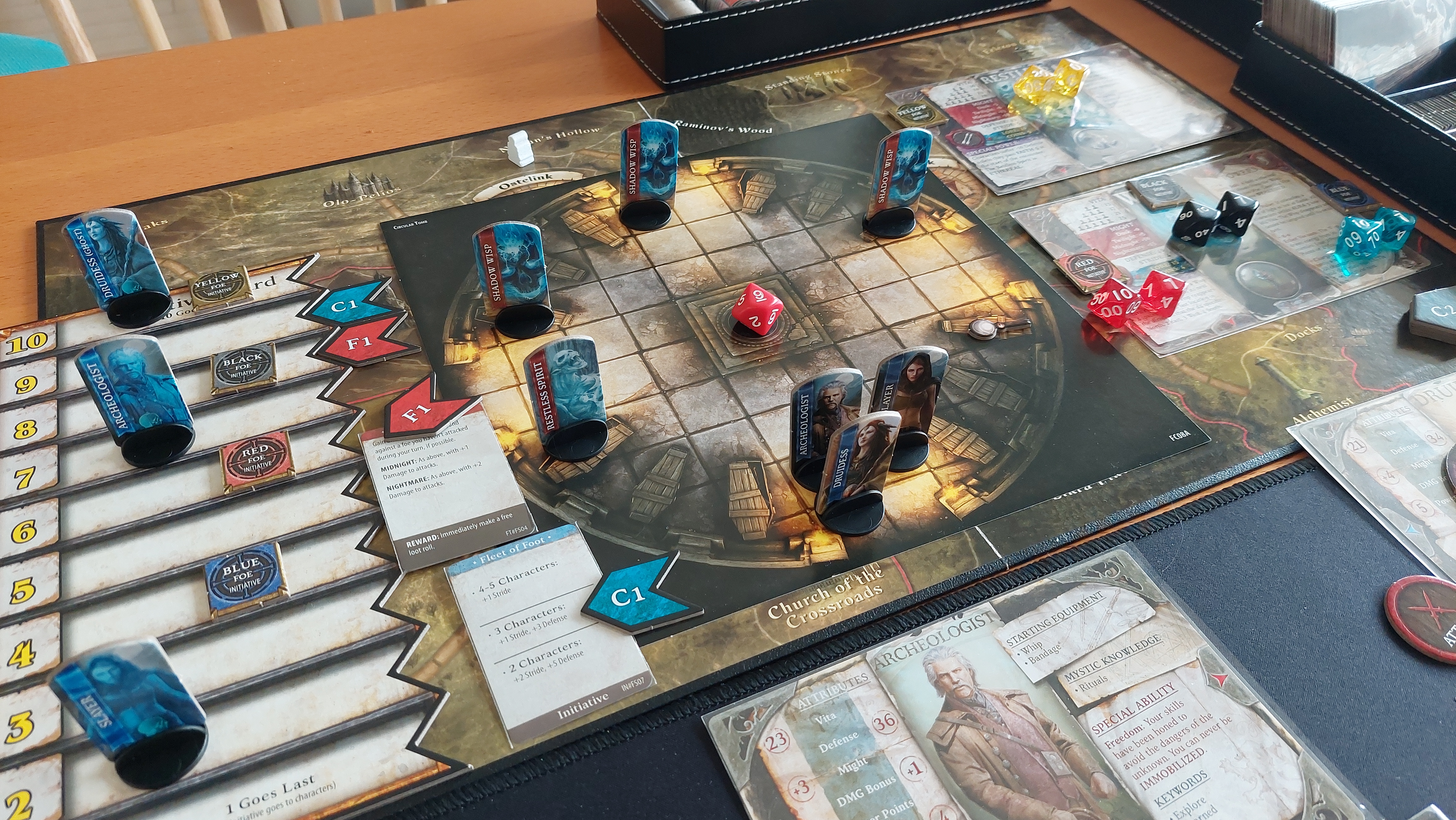
You can see this system in the image below. The track is at left, with a mix of standees and tokens to represent where combatants are on the track, and tactics cards (the blue and red arrows) being available.

Folklore: The Affliction combat and initiative track.


Punishing overland travel

The very well-realised world you travel through is a big plus of the game for me. It is dark and dangerous, and so it can also be incredibly punishing. As you travel you will have road or off-road encounters. Many of these lead to 'Skirmishes'. Usually quick to resolve they don't involve any setup or standees - a lovely system. BUT, these can happen way too often, and if you have bad rolls they end up really stomping you. Especially if you play the core rules, you have limited options to rest, making these skirmishes particularly deadly.

On the road again. The white party marker is at Waylin Point.


The best way to mitigate this I found was including a 'cautious travel/ fast travel' mechanic. Full credit to William Shaffer, who outlined this and other ideas on this thread.

When traveling on road, the party can travel cautiously or hastily. When traveling cautiously, you only draw an event of a result of 1-5 on a d10. When traveling hastily, you always draw an event, but you add +2 to your movement (+3 with a carriage). This allows the party to better control the flow of travel depending on how prepared they feel. You always draw an event when traveling off-road, and cannot travel hastily. I like this house rule because I don't want to burn through all the road event cards too fast, and it avoids the tedium of getting too many skirmish battles.

A detailed world: Just add two drops of depth

As you travel the world presented, the theme here really shines through. One example is visiting one of the three towns on the map. Each is of a different size and when you arrive, the game provides you with different locations (market, stables, chapel, alchemist, gypsy encampment, tinker etc.) Depending on the character you have chosen, you may get different bonuses or access to different services or things to buy. This is really great, as it helps you feel that you character is different. One issue however is that in the core game, the marketplace is quite sterile - in fact barren! Very few items are available to purchase by default. William Shaffer (see link above) offers a variant marketplace that makes the market...feel like a market!

'When shopping at a marketplace, you can draw either 5/10/15 consumables to buy from and 3/5/9 weapons/armor/enhancements per visit to the city (the slashes denote the size of the city).'

With this simple change (provided you have the money) you have some difficult decisions to make and levelling up feels like a real opportunity to spend your newfound wealth. It may make the game a little easier, by having more items available in town, but if that worries you make the market 'dynamic': Every time you visit shuffle the marketplace cards, and remove 2-3 at random - dwindling supplies are an every day occurrence for the citizenry of Kremel...

The change above is easy to make, but the second is part of one of the expansions: the 'Rumor' system. This was introduced in the 'Dark Tales' expansion of 2017. In this, you always have the chance to visit one of the local pubs in town, and once there you can pick up a 'rumor' to follow. Essentially this is a side-quest. 

You can see an example rumor card here:
Image: Boardgamegeekstore.com

Each rumor offers you a chance to pick up lore and coins (or other rewards) by completing the side quest. I really have been enjoying these because they help you level up and pick up coin that you can spend at the marketplace. They are also a nice diversion from the main story that can be played separately.

Busy bookkeeping - Folklore; the Affliction Assistant

Depending on what you are looking for in a game, the amount of bookkeeping in F:TA can be a plus or a minus. On the positive side it really gives you an old-school RPG feeling. You have a character sheet (or several) with a range of stats that change as you adventure and also contribute to your dice rolls. That pen-and-paper RPG feel is a plus for me, but it can get REALLY busy, even when using a fan-made PDF (see BGG files for more info.) This can be particularly true when playing solo with more than a single character.

The answer to this issue for me was to use the fan-made app on my Android phone. 'Folklore Assistant' is on Google Play (I don't think it is available for Apple devices but please check.). Kudos to the developer for their work on this. They are responsive to issues and the updates have been really useful to me. 

Eryalana, the Druidess

All cards and tokens are included

Stats are easy to track

Combat can be done in app


The app allows you to do all the bookkeeping that you normally need, just as if you were using a printed character sheet. As you add equipment and level up, your stats automatically adjust. However it ALSO allows you to manage combat in the app, export your characters, and play background music!

So that is how I've been enjoying Folklore! The core experience is really solid, but to get the right blend of challenge and fun (for me) it needed a few easy house rules. Adventuring in this world has brought me lots of really enjoyable hours at the kitchen table - with many more to come.

Tuesday, September 13, 2022

Folklore The Affliction. Problems and Solutions (Part 1.)

 Folklore...

...the Affliction' update:


It's been a long time (months!) between posts. 

In my 'cheap organizer solution' post for Folklore the Affliction, I had ended with a cryptic '...while exploring all the boxes and fitting everything together I discovered a BIG PROBLEM (To be continued)' and then never wrote a follow-up!

However a Gmail notification let me know that an anonymous comment had asked, '...to be continued, when?' and that has spurred me into this post - an update on the problem and then another post on my experience with the game. 

What was the big problem? In this post I'll address one problem, and in the next some gameplay challenges that I encountered.

'Affliction' indeed...

As you can tell in the organizer post, I was really enjoying finding a way to store the game, and I managed to get everything together in one box - the base game box. As is usual for me, as I played through the game I had been checking BGG and Reddit posts for information about the game - rules clarifications and such - and I came across posts about a mould issue with the Fall of the Spire expansion. In short, some of the boxes for the expansion were found to have mould, which kicked off a number of issues for the publisher and the Kickstarter. 

I checked my boxes, and sure enough, I had been 'afflicted' with mould in both the Fall of the Spire expansion and the core game box. A bit difficult to see in these images, but there it is!


 'No problem!' I thought - this mould is not harmful, and it can be removed. On reflection though I decided they had to go. I live in a country that can get very, VERY humid in summer and all my boxes are stored packed closely together in a cupboard which is not air-conditioned. Was the amount of mould excessive? Maybe, maybe not, but in the end I wasn't comfortable with the situation, so I binned both boxes.

I sent a polite email to the publisher asking about a replacement box, but didn't hear anything back. That was a shame - I know they had done the right thing when this issue was discovered by communicating with their backers - so I had hoped for some response. I know they have also had problems with their website over the months and again, there is some concern now that they have gone out of business. (Which I truly hope is not the case! This is an excellent game.) We are now several years past the release, so it also wouldn't be surprising if there were no replacement boxes available.

Unfortunately, getting the original boxes also proved to be difficult on ebay as well. If you can find an empty box, it can be about 20~30 USD, with another 20 USD for shipping. As much as I like the game, that doesn't make sense for me so (for now) all my Folklore materials are in the Dark Tales box.

I'll keep an eye out for a cheap box by haunting the usual places, but I'm not getting my hopes up. For now, everything fits into a mould-free box, and that is OK with me.

See you next time, when I provide an update on how the game has been to play, and approaches to house rules that have significantly improved my enjoyment of the excellent title.

Bye for now and thanks for reading.

Sunday, April 24, 2022

Half-day DIY: Dirt Cheap Game Card Holder

 In Folklore: The Affliction...


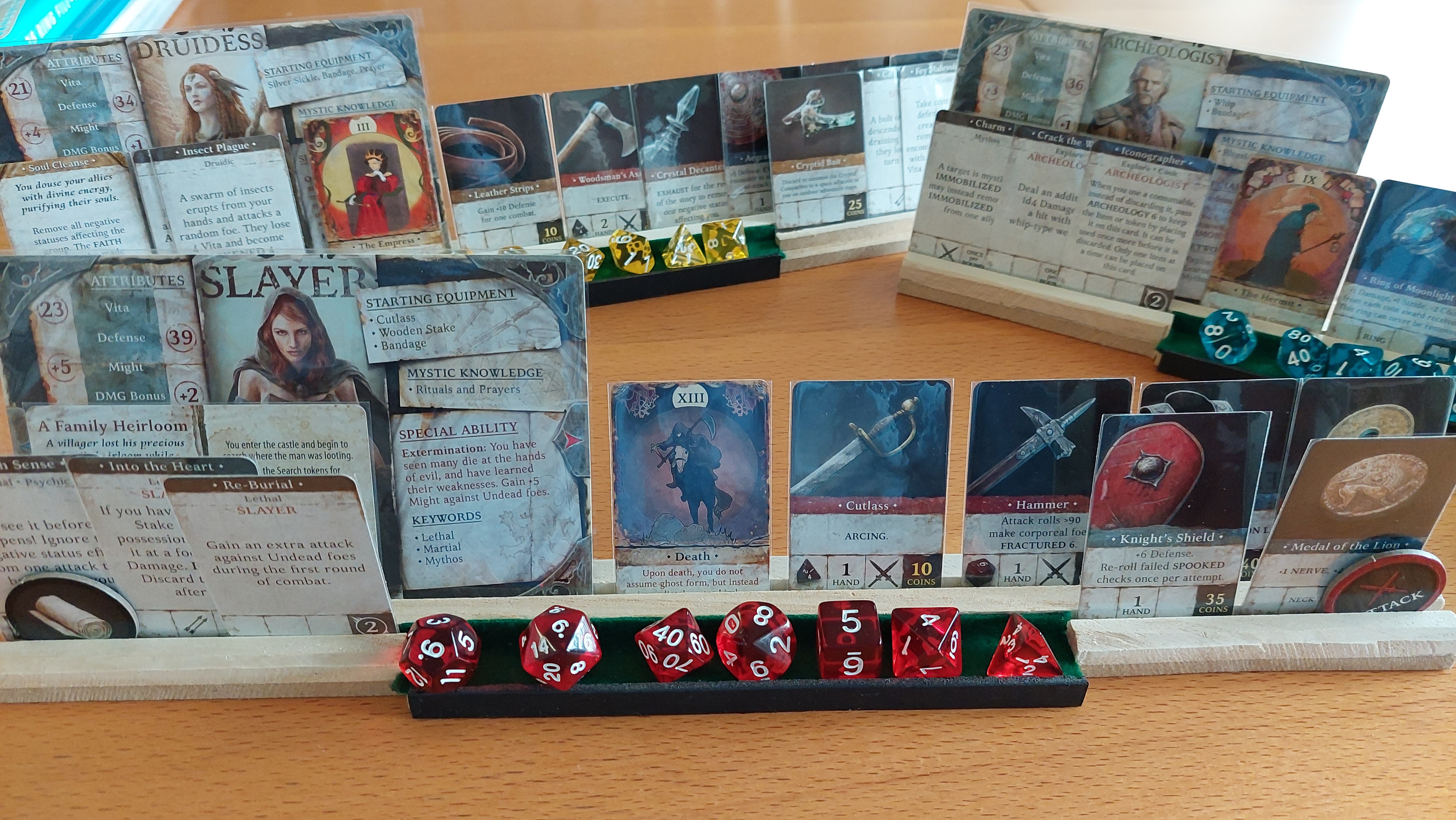
...space is at a premium, especially if you are playing solo, and even more so if the only place you can game is a small kitchen table. In the image above I have three characters and their equipment laid out before me (using the sold-separately Equipment Pack). There isn't really any room to write, update my stat sheet, or put a rulebook (or a fourth party member). Also, the more I go through a session, the more cards get messed up. After my last session, I decided I had to get better organized - ideally giving me more table space.

A short Amazon search later, I noticed that there are plenty of 'Game Card Holders' for playing cards. Ranging in price from 10$ to 30$ (before shipping) these come in plenty of different sizes and materials - with wood naturally being more expensive.

I like the idea, but not the price. With a 100Yen/ Dollar Store near me (Daiso) could I put something together? Sure, it probably won't look as nice, but here is what I came up with.

Materials


  • MDF board x1 (200mm x 400mm x 6mm/ 7.87in x 15.75in x 0.24 in) - 1~2 USD
  • Wooden square rods x4 (910mm x 9mm 35.82in x 0.35in) - 2 USD
  • Wood Glue (white glue/ 'Elmer's Glue') - 1 USD
  • Saw
  • Pencil (for marking out)
  • Felt (optional)

Result

Here is what we ended up with, including some measurements, and some photos of the card holders in action.

I included a small dice tray at the front, and lined that with cheap green felt offcuts.


...and there you go. I like the end result. Due to the plain wood they look cheap - because they are - but they get the job done.

:-)

Happy gaming

Monday, April 4, 2022

Folklore The Affliction: Cheap organizer solution


The Game

Folklore: The Affliction is a tabletop 'RPG in a box', published by Greenbrier games. According to Boardgame Geek the core box was published in 2017. Expansions were released in 2017 (Dark Tales) and 2021 (Fall of the Spire). 

After watching a lot of reviews, I decided to purchase the core set. Despite having some flaws that most reviewers seemed to agree on (what game doesn't?) I felt the game offered me plenty of elements that I am currently looking for:
  • A game with lots of 'theme'.
  • Opportunities for roleplaying.
  • Captures the feeling of an 'RPG', with a story you can move through with characters.
  • Dice chucking, combat, and character management (lots of stat management on character sheets!)
  • No model painting (a second printing comes complete with standees.)
After the game arrived, I played a chapter solo (with a party of three characters) and really enjoyed it (despite a hard party wipe at the final battle!) I looked around further and discovered that the expansions offered new stories, rules and systems that would take the world of the game to another level. I invested in both expansions (rather than just use the rules PDFs) and both boxes duly arrived (and the 'Equipment' pack, which includes cards for all the equipment in the game.)

The Challenge

I find Folklore to be a gorgeous game with lots of high-quality components. A thick map of the world, tactical maps (on thin card), standees, mini-Euro sized cards for components and abilities etc. 

Did I say 'lots'? Let's see how many components we are talking about?
By my count: 1,615 bits and pieces (I may have made some mistakes, but I totaled publicly available info in this Google sheet.)

Living in an apartment in Japan, I don't have a lot of storage space. Could I fit all of this into a single DIY box organizer? If so, how?

The Tools

In the past I've made my own box organizers from foam core for Descent 2e, and Mansions of Madness 2e. I enjoyed the challenge but it can be very time consuming. In my lazier (or more lucid!) moments, I've found the 100 Yen shops here in Japan a great way to get small storage bits and pieces and organize boxes at low cost. I did that with Gloomhaven and most recently with my Mage Knight organizer

So what to do with Folklore, where I want to get the content from three boxes into one? Some creative 100 Yen shopping was in order. After a few shopping trips (including carrying the box in with me for some testing) here is what I ended up with!

  • x6 'PU' (Polyurethane) fake Leather' trays. (600 yen, approx 5 USD)
  • x3 acrylic token trays (each with 5 sections) (300 yen, approx 2.45 USD)
  • x1 'Cube' storage box with drawer (100 yen, approx 0.80 USD)
  • x1 foamboard (black). 10mm thickness (100 yen, approx 0.80 USD)
  • x1 glue gun (200 yen/ 1.60 USD) with x20 black glue sticks (100 yen/ 0.80 USD)
  • x2 sets of three 'Book bands' (200 yen/ 1.60 USD). Basically giant elastic bands.
Total cost: 1,600 Yen or approx 13.05 USD.
For reference, here are a couple of images of the most important parts. If you can't get these, you may be able to find something of the same size OR create them from foamboard.

'PU leather' tray. (26cm x 10cm x 4cm) I used 6 of these.

'PU (fake) leather tray details/ dimensions

'Multi-connect box'. x1 (8cm x 7.7 x 8)

Multi-connect box dimensions.

Glue gun. This uses 7.5mm glue sticks

Clear acrylic tray. x3 (17.8cm x 7.2 x 3.0 )

The Result

In the photos below, let's open the box and explore layer-by-layer. (Stay with me - lots of photos!)

Top layer: rulebooks, world map, tactical maps


The box: yes, it doesn't close (a possible deal-breaker for some), 
but fixable with foamboard 'walls'.

Top layer includes the fold-up map...

...rulebook and all three Story Journals...


Underneath the journals are all the tactical maps.

Lay the maps aside and here is a foam card topper.

Bottom layer: standees, cards, and tokens

Then we reach the core of the box. A PU leather standee tray, a 
central 'valley' with enemy cards, and a DIY card holder (black, at top).
Also made of PU leather trays x2 (one of which is used as a lid)

The standee tray (bottom) holds just over 200 standees. Enemies
are sorted alphabetically L-R, with characters at right.

Removing the PU box cover at top reveals it to be another PU tray,
to which I've added some partitions (glue gun).
The bottom half holds all the mini-Euro sized cards.

Here is that layer again in full!

Standee tray removed. Underneath is another PU leather tray,
within which is our first acrylic token tray and Town events deck.

Zooming in, you can also see the initiative track (vertical, at left)
and the character cards (vertical, at right.) Top right there are three
small grey pouches. What is in them?

Each pouch contains the equipment and ability cards for
one of my party members (I run with three.)

I've readied the initiative track (L) and pulled out the PU 
leather tray and placed it to the right. This has revealed
another PU leather tray With Road events deck and another acrylic tray beneath.

At the top of the box is a matching PU leather tray, with
the Rumor deck and other tokens.

The enemy and character cards from the 'valley' and which
are tucked down the side of the box are removed.


With most of the trays out, we can see the small storage box
that contains miscellaneous tokens and other (easily lost!) pieces.

Dice are also held in a small pouch. Let's roll!

So with most things out, you can see the cards 'ready to play' 
(at right), so they can be easily drawn.

Here is another view. Note how the small cards are stacked
vertically in the space between the acrylic trays and the PU leather trays
-ready to be used.

Here is another view.

Phew! There is a lot of stuff. The positive is that I can get everything into 'one box'. The issue is that the lid doesn't close. That annoys me, but I'm thinking of adding in some foam or plastic walls to add some rigidity and hide the insides.

Overall, I'm very happy with getting everything together BUT...

...while exploring all the boxes and fitting everything together I discovered a BIG problem.

(To be continued.)

Related Posts Plugin for WordPress, Blogger...